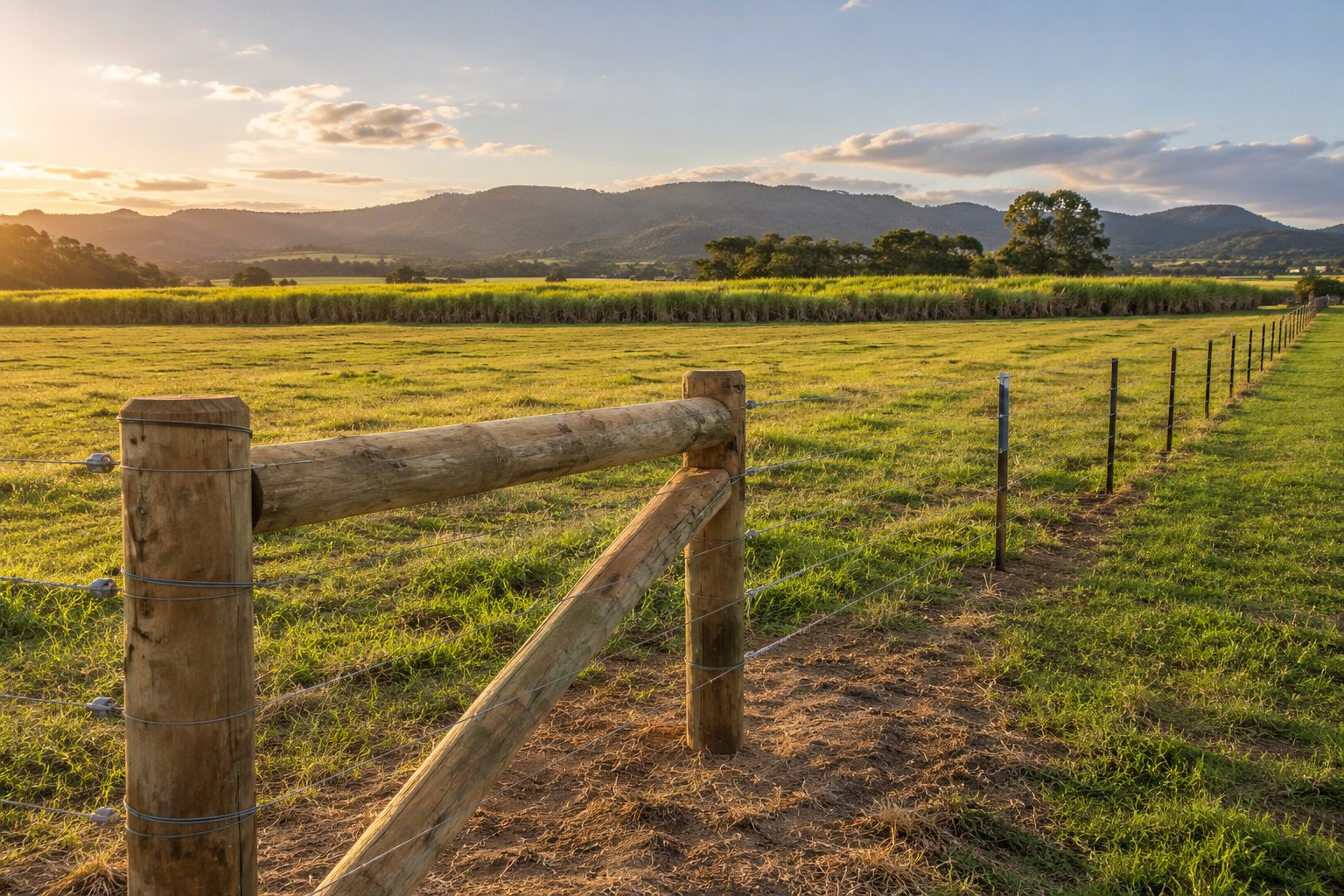
Rural Fencing in Mackay & the Pioneer Valley
Cattle, cane, horse and exclusion fencing, plus storm and flood repairs, passed to local fencing contractors across three council areas.
Tell us where the fence is and what it has to do
The town, what the fence must hold or keep out, and who the neighbour is. A photo of the fence line and a rough length are enough to begin. Your enquiry is passed to a local contractor. This site does not build fences or quote.
Request a quote
Beef, cane and coal country on a wet, cyclone-exposed coast.
The Queensland Government region profile for Mackay, Isaac and Whitsunday gives 186,512 residents in 2023 and calls the beef cattle industry the largest agricultural production sector, at an estimated $627 million. Sugar cane is given as $329.3 million, and horticulture, the largest winter produce growing region, as more than $233 million. The page attributes all three to ABARES, 2020 (Queensland Government region profile).
At the 2021 Census coal mining was the first-listed industry of employment in every locality and area we looked at except Proserpine locality and urban centre, where supermarkets led. In the Mackay statistical area (121,691 people) it was 9.5 per cent. Separate houses ran from 77.7 per cent of dwellings in the Proserpine urban centre to 98.9 per cent in Marian. That hints at many rural residential blocks, but it is inference only: no census page we read gives lot sizes.
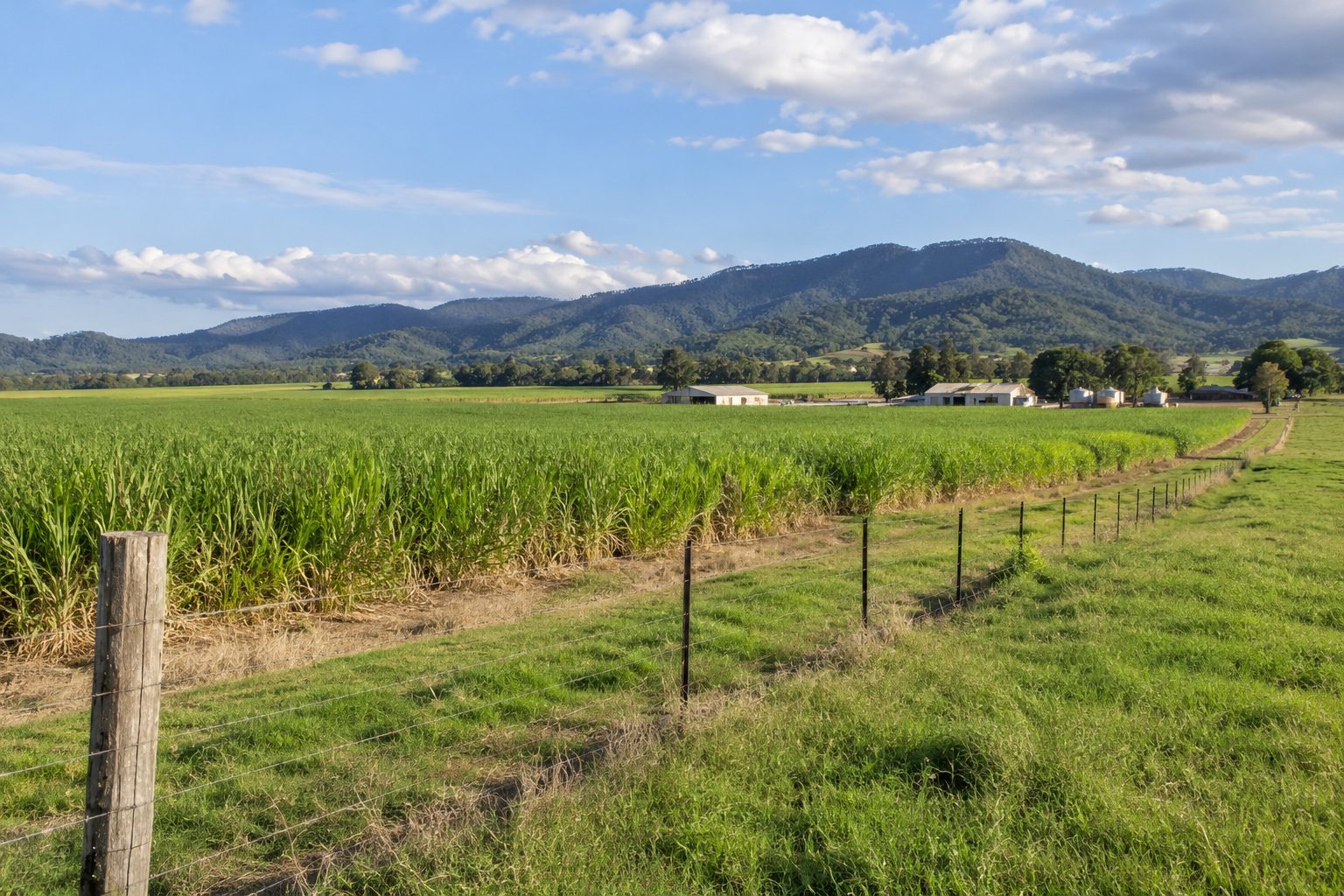
Three councils are involved: Mackay Regional, Whitsunday Regional and Isaac Regional. Rural fencing here means cattle and paddock fences, cane boundaries, exclusion fences for pigs and wild dogs, horse and acreage fences, and storm and flood repair. Who pays for a boundary fence, in full
What to settle before you book
- Town and council areaMackay Regional, Whitsunday Regional or Isaac Regional. See the Mackay and Nebo pages.
- What the fence must holdCattle, pigs, wild dogs or horses. See the cattle, exclusion and horse pages.
- Boundary or internal fenceThe dividing fence law is about fences between neighbours. An internal fence is between you and the contractor.
- Who the neighbour isCane, grazing, a residential block, a road, a stock route or a creek. See the cane boundary page.
- Ground and flood exposureAsk how the quote treats low, wet or flood-prone ground. See the storm and flood page.
- Access in the wet seasonAsk how rain, and on cane country the crushing season, affect access to the block.
- Whether a neighbour notice has been servedSee the notice and QCAT page.
- A written quote and the licence heldItemised in writing, naming the licence or registration.
Rural fencing services around Mackay
Cattle & farm fencing
Post and wire for grazing country: the parts, strainers and gates, the livestock test for a boundary and what a quote should cover.
Read more →Cane farm boundary fencing
Boundaries between cane blocks, roads and neighbours, flood country and what the Queensland fence Act says about agricultural land.
Read more →Pig & wild dog exclusion
The designs a regional fact sheet publishes, and what to confirm before you order an exclusion fence.
Read more →Horse & lifestyle block fencing
Fencing for rural residential blocks and horse paddocks, the neighbour rules that are still unsettled and the quote checks.
Read more →Storm & flood fence repair
Rebuilding after cyclones and floods: flood-friendly design points, earthworks and the recovery funding that was announced.
Read more →What affects the cost
The factors that move a rural fencing quote in Mackay country, and a checklist for comparing written quotes line by line.
Read more →The dividing fence Act in short
Each row uses the Neighbourhood Disputes (Dividing Fences and Trees) Act 2011 in the version we found, in force from 1 August 2025. Later amendments were not checked. Some State web summaries word the agricultural land rule more loosely than the Act, and this site uses the Act's wording.
| Point | What the Act's words say |
|---|---|
| Equal share | Section 21(1): "Adjoining owners are each liable to contribute equally to carrying out fencing work for a sufficient dividing fence." |
| A higher standard | Section 21(2): an owner who wants a higher standard is liable for the work "to the extent that it is greater than the standard for a sufficient dividing fence". |
| Two grazing parcels | Section 13(1)(b): the fence must be sufficient to "restrain livestock of the type grazing on each of the parcels of land". The Act sets no height for pastoral land. |
| Two parcels of agricultural land | Section 8(3): "For adjoining land consisting of 2 parcels of agricultural land, this chapter does not apply to each parcel of land for the common boundary between the parcels of land." |
| After a notice | Section 31(6): no agreement within one month after the notice is given, then either owner may apply to QCAT within two months after the notice is given. |
| Stock routes and State land | Section 8(2)(a) names a stock route and section 8(4) unallocated State land as outside the chapter. |
Cane beside grazing land, a lifestyle block, a road or a creek is not settled by these words, and we do not interpret it. Ask QCAT, the council or a solicitor. See the dividing fence law page and the notice and QCAT page.
Licensing: a gap this site does not fill
Whether a rural fence needs a QBCC licence is not something the pages we found settle, and this site makes no claim either way. The contractor is responsible for holding any licence or registration that applies. Ask the contractor which one they hold, check it on the QBCC register (139 333), and ask QBCC if you are unsure.
What the QBCC pages say, which regulation provisions mention farm fences and where the text stops are set out on the farm fence licence page. Contracts, deposits and the cooling-off period are covered there too, framed as applying if the work is building work.
Wet season, cyclones and access
At the Mackay M.O. station, with a record from 1959, the mean annual rainfall is 1,597.3 mm. About 75 per cent of it falls from December to April, and about 12 per cent from June to October (Bureau of Meteorology). The council's hazard calendar gives the wet season, 1 November to May, as when flood risk is mainly high, and says flooding can happen at any time of year (Mackay Regional Council). Cane crushing season and the wet season compete for access on cane country, so ask the contractor how they plan around both. The seasons guide has the monthly table.
What this site cannot do
This site cannot build, quote, inspect or sign off a fence. It cannot tell you which licence or registration a contractor needs, because the pages we found do not settle it, or confirm that any contractor holds one. It cannot say whether a rural fence needs council approval, because the Mackay planning pages we found do not mention fences. It cannot decide a dispute with a neighbour, serve a notice or apply for a grant for you. Those belong to the contractor, QBCC, the council, QCAT, QRIDA and a solicitor.
Check the current rules before you rely on this
This page describes the Queensland dividing fence Act in outline, the licensing gap, the region's farming mix and the Mackay rainfall record. It describes the rules in general terms as they stood in November 2026. Standards, forms, thresholds and fines change.
The authoritative sources are Neighbourhood Disputes (Dividing Fences and Trees) Act 2011 (Qld), version in force from 1 August 2025, QBCC, find a licensed contractor (licensee register, 139 333), QCAT, dividing fence disputes (process and time limits), Queensland Government, Mackay, Isaac and Whitsunday region profile (industry figures attributed to ABARES 2020) and Bureau of Meteorology, Mackay M.O. climate statistics (station 033119, record from 1959). Where anything here differs from those sources, they are right and we are not.
We are not fencing contractors, builders, regulators or lawyers. For what applies to your fence, ask the contractor which licence or registration they hold and check it on the QBCC register (139 333), then ask the council that covers the land: Mackay Regional Council (1300 622 529), Whitsunday Regional Council (1300 972 753) or Isaac Regional Council (contact details on its website).
Accurate at the time of writing, November 2026. Always check the source before relying on it.
Towns and districts covered:
Local pages: Mackay and the city fringe, Walkerston, Marian, Eton and Mirani, Sarina and Plane Creek, Proserpine and Calen and Nebo and Broadsound.
What a rural fencing quote should itemise
This site publishes no prices. Make each written quote spell out the same things, so they can be compared line by line.
| Line | What to ask |
|---|---|
| Fence length and line | Who locates the line, and from what. |
| Strainers and gates | How many, of what type, and where. |
| Posts | Timber or steel, the treatment or galvanising, the spacing. |
| Wire | Plain or barbed, the number of strands, the gauge. |
| Tying off and tension | How the wire is strained and tied off. |
| Earthworks and flood design | What is allowed for on low or flood-prone ground. |
| Vegetation clearing | Who clears, how wide, and who confirms the vegetation category. |
| Underground services check | Whether it is done before posts or pickets go in. |
| Electric parts and earthing | Energiser, insulators and earth stakes, if electric. |
| Post driver safety | What arrangements the contractor uses. |
| Licence or registration | Which one is held, checked on the QBCC register. |
| Neighbour notice | Who serves any notice, and who pays for quotes. |
| Several quotes | One regional fact sheet calls getting several quotes critical. |
The cost guide goes through each factor, and the contact page lists what to send.
Things landholders around Mackay ask
Who pays for a fence between two rural properties in Queensland?
In the version of the Act we found, adjoining owners are each liable to contribute equally to a sufficient dividing fence, and an owner who wants a higher standard pays the extra. The chapter does not apply to the common boundary between two parcels of agricultural land (s 8(3)). Between two grazing parcels the fence must restrain the stock on each. For mixed boundaries, ask QCAT, the council or a solicitor.
Do two cane farms have to share a boundary fence?
The Act says that for adjoining land consisting of 2 parcels of agricultural land, the chapter does not apply to each parcel of land for the common boundary. Agricultural land means rural land of more than half a hectare used for cultivating crops on a commercial basis. Cane beside grazing land, a lifestyle block, a road or a creek is not settled by those words, so ask QCAT, the council or a solicitor.
Do I need a QBCC licence to build a farm fence?
The pages we found leave this open, so here is where they stop. The QBCC threshold pages we found do not mention fences, and one undated QBCC fact sheet we found speaks about fences but we could not confirm it is current. The regulation lists farm fence work among work that is not building work, but we could not read the conditions. Ask the contractor which licence they hold, check it on the QBCC register (139 333), and ask QBCC if you are unsure.
How long do I wait after a fencing notice?
Under s 31(6) of the Act, if the owners have not agreed within one month after the notice is given, either owner may apply to QCAT within two months after the notice is given. So the wait is one month, and the window for applying closes two months from the notice. A written quotation goes with the notice. Urgent work follows a different path, set out on the notice page.
How much does rural fencing cost per metre around Mackay?
This site publishes no cost figures, because one number would be wrong for most blocks. What moves a quote is the fence type and number of strands, length, terrain and access, strainers and gates, flood design and earthworks, clearing, and wet-season access. Ask for itemised written quotes and compare them line by line using the cost guide.
What fence keeps feral pigs out?
One regional fact sheet, general information and not a mandatory standard, says standard feral pig exclusion fencing should be a minimum 1200 mm high, with mesh of about 150 mm secured to the ground, and barbed or electric wire 10 to 20 cm off the ground to help stop pigs lifting the netting. The pig and wild dog page has the wild dog heights and what to confirm before ordering.
Can I clear trees to put in a fence line?
Queensland Government pages list an exemption for clearing to establish a necessary fence, road or vehicular track to a maximum width of 10m, for some vegetation categories only. Clearing for several purposes cannot be combined into a wider strip, and the exemption may not apply where there are development approval conditions, a covenant, an offset or a declared area. Confirm the category and conditions, and ask the council.
Is there help to repair fences after the 2025-26 cyclones and floods?
As at November 2026, a QRIDA program page for the North Queensland monsoon trough event lists repairing or replacing fencing not covered by any other assistance for primary producers, and names Mackay Regional Council as a defined disaster area. It says primary producer grants close 6 January 2027, or earlier if funding runs out. Confirm with QRIDA on 1800 623 946. Whitsunday and Isaac areas were not checked, so ask QRIDA.
Send a town, a photo and what is next door
The town, what the fence must hold or keep out, who the neighbour is, and roughly how long it is.