Dividing fence law in Queensland: who pays
Dividing fence law in Queensland sits in the Neighbourhood Disputes (Dividing Fences and Trees) Act 2011 (the Act). We read the version in force from 1 August 2025. Later amendments were not checked, so everything below is "in the version we found". Section 21(1) reads: "Adjoining owners are each liable to contribute equally to carrying out fencing work for a sufficient dividing fence." Under s 21(2), an owner who wants a higher standard is liable for the fencing work "to the extent that it is greater than the standard for a sufficient dividing fence".
The Queensland Government's fence owner page puts it in plain words: a dividing fence on the common boundary line is owned equally, each neighbour is generally liable for half the cost, and a neighbour who wants more than a sufficient fence pays the difference (Queensland Government, your responsibility as a fence owner). QCAT can help with disputes valued up to and including $25,000. But the Act does not reach every boundary, and on rural land that matters.
Which land the Act covers, and the s 8(3) carve-out
Section 8(1) lists the land the chapter applies to, including "land recorded in the freehold land register;" (s 8(1)(a)) and "land subject to a lease or licence under the Land Act 1994;" (s 8(1)(b)). Two things are outside it. Section 8(2)(a) says the chapter does not apply to "a stock route within the meaning of the Stock Route Management Act 2002", and s 8(4) says "this chapter does not apply to unallocated State land".
Then the carve-out for farm boundaries, s 8(3): "For adjoining land consisting of 2 parcels of agricultural land, this chapter does not apply to each parcel of land for the common boundary between the parcels of land." Section 18 defines the terms: "Agricultural land is rural land of more than half a hectare used for cultivating crops on a commercial basis". "Pastoral land is rural land of more than half a hectare used for grazing stock on a commercial basis".
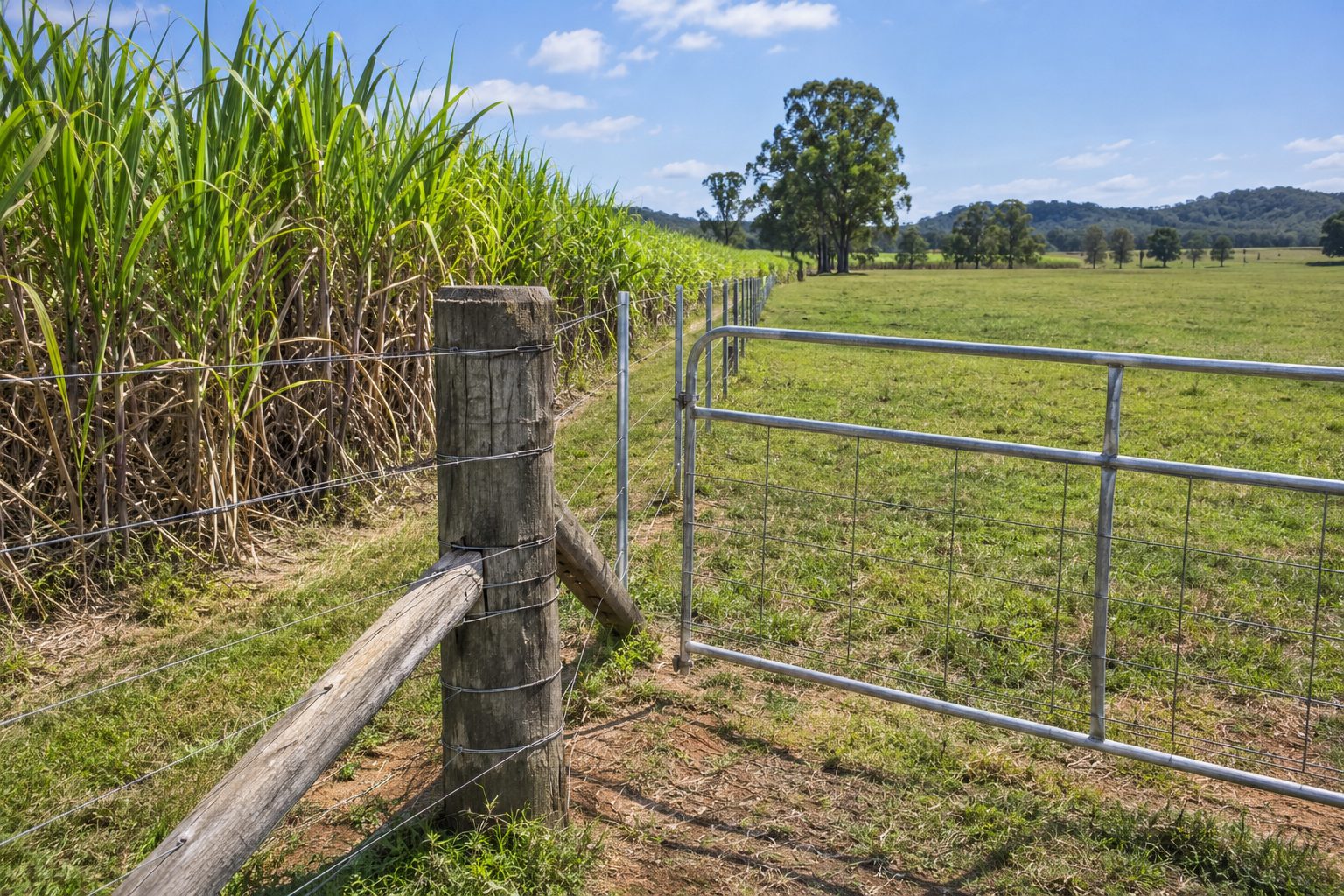
That makes s 8(3) a crop-to-crop rule. A boundary between two parcels of agricultural land, such as two cane blocks, is outside the chapter on the common boundary. A boundary between two parcels of pastoral land, such as two grazing properties, is inside it, and the livestock test below applies. Some State web summaries word the agricultural land rule more loosely than the Act. This site uses the Act's wording, and where the two differ the Act is the authority.
| The boundary | What the Act's words cover | Where to go |
|---|---|---|
| Two cane blocks | Two parcels of agricultural land: s 8(3) says the chapter does not apply to each parcel for the common boundary. | Agreement between the neighbours. The cane boundary page applies this to cane. |
| Two grazing properties | Two parcels of pastoral land: inside the chapter, with the s 13(1)(b) livestock test. | The notice and QCAT steps |
| A cane block beside grazing land | The words quoted above do not speak to this pairing. We do not interpret it. | QCAT, the council or a solicitor |
| A lifestyle block beside cane or grazing | See s 18 on prescribed rural land and the heading of s 22. How the Act applies is unresolved here. | QCAT, the council or a solicitor |
| A road between the parcels | Section 15(2) speaks to owners on either side of a road (see below). | QCAT, the council or a solicitor |
| A creek or watercourse | Section 12(2) deals with a fence built on a line other than the common boundary. Read the section for the conditions. | QCAT, the council or a solicitor |
| A stock route or unallocated State land | Sections 8(2)(a) and 8(4): the chapter does not apply. | The council that covers the land |
What counts as a sufficient dividing fence
Section 12(1): "A dividing fence means a fence on the common boundary of adjoining lands." Section 12(2) adds that a fence separating the land of adjoining owners, built on a line other than the common boundary, "is also a dividing fence if" conditions in the section are met. Read s 12(2) for the conditions; we have not listed them.
Section 13 sets the sufficiency test by kind of land. For residential land the fence "is between a minimum of 0.5m and a maximum of 1.8m in height". For two parcels of pastoral land, the dividing fence is sufficient to "restrain livestock of the type grazing on each of the parcels of land". And under s 13(1)(c)(i) a fence is sufficient if "the adjoining owners agree the dividing fence is a sufficient dividing fence". The Act sets no height for pastoral land. For grazing country the question is whether the fence restrains the stock, which the cattle and farm fencing page describes from a regional fact sheet.
Lifestyle blocks and prescribed rural land
Section 18 also says "Prescribed rural land is agricultural land, pastoral land or other rural land of more than half a hectare", and then continues, so see s 18 for the rest of the definition. "Residential land is land, other than agricultural land and pastoral land, used primarily for residential purposes." The heading of s 22 is "Contribution: parcel of prescribed rural land adjoining residential development".
That is as far as we read. How s 13 and s 22 apply to a lifestyle block of more than half a hectare beside cane or grazing land is unresolved on this site, and we do not interpret it. Ask QCAT, the council or a solicitor. The horse and lifestyle block page has the practical side.
Roads, creeks and the Crown
Section 15(2) says "the owners of agricultural land or pastoral land on either side of a road are adjoining owners if" the owners agree, or "QCAT decides a fence has been used, or could reasonably be used, as a dividing fence for the 2 parcels of land". We give that outline only. Creeks, road reserves and stock routes bring their own checks, set out on the creeks, roads and vegetation page.
The Queensland Law Handbook is a secondary source. The page we read was updated on 26 September 2024 and first published on 19 July 2016, and its disclaimer says the content reflects the law "as at July 2016" (Queensland Law Handbook, dividing fences). It says a dividing fence is not required where both parcels are agricultural land and the neighbours rely on agreement or common law, that agreements generally do not bind later buyers, and that the Crown does not have to contribute when bordering Crown land that is not leased or freehold. Treat it as background, not as the Act.
Other fences, the council and QCAT
Pool-barrier fences follow separate Queensland rules, the pool owner who needs the work generally pays, and they are not covered here (Queensland Government page on separate rules).
Councils do not run fence disputes. Mackay Regional Council's dividing fence page does not describe a council role, refers readers to the State, and names a "Notice for contribution to fencing work" form (Mackay Regional Council, dividing fences). Its customer service centres are at Mackay (Gordon Street), Mirani (20 Victoria Street) and Sarina (65 Broad Street), Monday to Friday 9am to 4pm. For land in the Whitsunday or Isaac council areas, ask those councils. QCAT has jurisdiction under the Act, and the notice and QCAT steps page sets out the order. For what the contractor should hold, see the licence page, and send your enquiry when you are ready.
What this page cannot do
This page cannot tell you whether the Act applies to your boundary, who must pay, or what a court or QCAT would decide. It gives the Act's words as we read them in the version in force from 1 August 2025, not legal advice, and it does not interpret a cane block beside grazing land, a lifestyle block, a road, a creek or a stock route. Later amendments were not checked. We are a referral service: we pass your enquiry to local contractors. For your boundary, ask QCAT, the council or a solicitor.
Check the current rules before you rely on this
This page describes the dividing fence rules in the Neighbourhood Disputes (Dividing Fences and Trees) Act 2011 as we read them, and what the State and council pages add. It describes the rules in general terms as they stood in November 2026. Standards, forms, thresholds and fines change.
The authoritative sources are Neighbourhood Disputes (Dividing Fences and Trees) Act 2011 (Qld), version in force from 1 August 2025, Queensland Government, your responsibility as a fence owner (its agricultural wording is looser than the Act), QCAT, dividing fence disputes (process and time limits), Queensland Law Handbook, disputes with a neighbour over dividing fences (secondary; page dated September 2024, disclaimer as at July 2016) and Mackay Regional Council, dividing fences. Where anything here differs from those sources, they are right and we are not.
We are not fencing contractors, builders, regulators or lawyers. For what applies to your boundary, ask QCAT, read the Queensland Government fence owner page or speak to a solicitor, and ask the council that covers the land: Mackay Regional Council (1300 622 529), Whitsunday Regional Council (1300 972 753) or Isaac Regional Council (see its website). The contractor is responsible for holding any licence or registration that applies.
Accurate at the time of writing, November 2026. Always check the source before relying on it.