What moves the cost of rural fencing in Mackay country
How much does rural fencing cost around Mackay? A figure means little until the line, the ground, the ends and the gates are known, so this guide gives no prices or rates. It lists what moves a quote and what a written quote should itemise, so two quotes can be compared line by line. Your enquiry is passed to local contractors, who price the job themselves and put it in writing.
The sources we read are general: a regional fact sheet, the Queensland dividing fence pages, the QBCC pages and a safety alert. They say what to ask and what to include. They do not say what a job should come to, and this page does not guess.
| Factor | How it moves a quote | What to tell the contractor |
|---|---|---|
| Fence type and strands | The kind of fence and the number of strands change the materials and the labour. One regional fact sheet describes its cattle design on the cattle and farm fencing page, and the exclusion designs are separate again. | What the fence must hold: cattle, pigs, dogs or horses |
| Length, terrain and access | A long line over hilly, rocky or scrubby ground takes more time than a short line on level ground. Delivery and machine access are part of the job. | Rough length, slope, gullies, gate positions and tracks |
| Strainers and gates | Each end, corner and gateway needs its own assembly, so a short fence with many gates cannot be priced by length alone. | Where the corners, gateways and direction changes fall |
| Flood design and earthworks | Extra earthworks and erosion control can be part of a fence in flood country. See the storm and flood repair page for the design points we read. | Whether the line crosses a drain, creek or flood path |
| Vegetation clearing | A fence line through scrub may need clearing. A State exemption allows clearing to a set width for some vegetation categories only, and the category is not something we can confirm for your block. | Who confirms the vegetation category, and who does the clearing |
| Boundary cost share | On a boundary fence the contractor quotes the fence, and the split is between you and your neighbour. A neighbour who wants a higher standard pays the extra. | Whether a neighbour notice has been served and who serves it |
| Wet-season and crushing-season access | Heavy rain can stop vehicles on the line, and a cane block may be busy at harvest. The seasons guide sets out what the sources say. | When the block can be reached, and by what |
| Exclusion mesh and apron, or plain electric | A pig or dog exclusion fence uses mesh and an apron or footer, and an electric option uses different parts. We give no ratio between them. | The animal, the height wanted and the maintenance plan |
Boundary fences: the split is a separate question
If the fence is on a boundary, the first question is not the contractor's price but whether the Queensland dividing fence Act applies and how the cost is shared. Under s 21(1) of the Act, in the version we found, adjoining owners are "each liable to contribute equally" to a sufficient dividing fence, and under s 21(2) an owner who wants a higher standard pays the extra. Whether the Act applies to your boundary at all depends on the land on each side, which the dividing fence law page sets out. Ask the contractor to quote the fence, not the split.
The QCAT page says at least one written quotation must be supplied with a neighbour notice, and recommends two as a courtesy (QCAT dividing fence disputes). It also says to wait one month for agreement before applying to QCAT, and not to start while the neighbour disputes the work. The notice and QCAT steps page has the order. The sources we read do not say who bears the cost of getting a quote, so ask each contractor whether quoting is part of the service.
A checklist for comparing written quotes
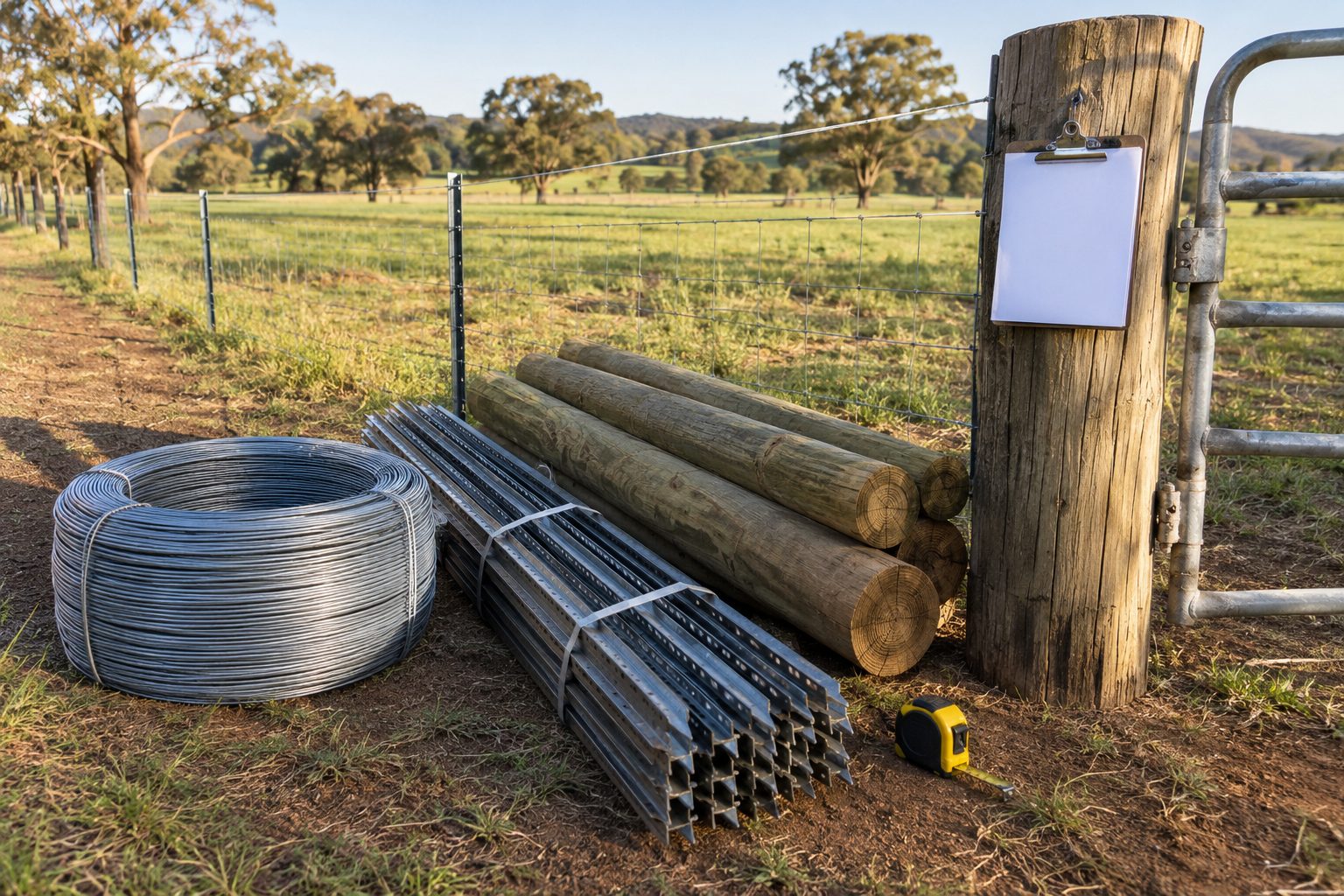
Ask for a written, itemised quote, and ask each contractor to cover the same list. One regional fact sheet says it is critical to obtain several quotes, given material shortages and price rises, and that local rural supply agencies are a good source of advice (a regional fence selection fact sheet). The sheet is general information and does not set mandatory standards. A quote should name:
- The line. The fence length, where it runs and how the boundary location is established.
- Strainers and gates. How many, what they are made of and where they go.
- Posts. The post type, and the treatment or galvanising. Ask which hazard class or hardwood species the posts are. The fence posts guide explains the hazard class question.
- Wire. The wire type and the number of strands, and how it is tied off and tensioned.
- Clearing. What is cleared, and who confirms the vegetation category.
- Flood design and earthworks. Anything allowed for erosion, debris or water flow.
- Underground services. Whether the services check was made before posts or pickets are driven. A carrier's media release says driving in a star picket is treated as ground-breaking work and to dial 1100 in business hours (a carrier's media release on dialling before you dig).
- Electric parts and earthing. Energiser, insulators and earth system, if the fence is electric. See the electric fencing guide.
- The notice. Who serves any neighbour notice on a boundary fence.
- The licence or registration held. See the section below.
Licence, building work and deposits
Ask which licence or registration the contractor holds, and check it on the QBCC register (QBCC licensee register, 139 333). The contractor is responsible for holding any licence or registration that applies. Also ask whether the work is building work. The QBCC pages we found do not say whether a rural fence is, so the answer comes from QBCC and the contractor, not from this site. The licence page sets out what the pages say and where they stop, including what they say about contracts and deposits if the work is building work.
Before you sign, ask what deposit is wanted and when it is due, and ask for the quote, the scope and any changes in writing.
The post driver and the people on your land
A quote can also state how the work will be done safely. A WorkSafe Queensland alert, updated in July 2026, describes a fatal injury in April 2024 when part of a tractor-linkage connection on a post driver failed (WorkSafe Queensland post driver alert). It recommends not relying on a single component to restrain the mast, a backup restraint such as a rated safety chain, a check of hoses, pins, brackets and welds before use, trained operators and keeping people clear. Ask the contractor to describe their arrangements.
What to send when you ask for quotes
The more the contractor knows, the closer the quote. Send the town, a photo of the fence line, the rough length, whether it is a boundary and who the neighbour is, the ground, any storm damage and its date, and how the block is reached in the wet season. For repairs, the storm and flood repair page has a repair quote check. For the other jobs, start with the cattle and farm fencing page.
What this page cannot do
This page cannot tell you what your fence will cost, because we publish no prices or rates and the sources we read give none. It cannot tell you whether the work is building work, which licence or registration applies, or whether your neighbour must share the cost. We are a referral service: we pass your enquiry to local contractors, who quote in writing and are responsible for holding any licence or registration that applies. Check anything that matters to your job with the contractor, QBCC and the council.
Check the current rules before you rely on this
This page describes the factors that move a rural fencing quote and the checks to run on it, with the sources we read. It describes the rules in general terms as they stood in November 2026. Standards, forms, thresholds and fines change.
The authoritative sources are A regional natural resource management body, fence selection fact sheet, August 2023 (general information, not mandatory standards), Queensland Government, your responsibility as a fence owner (its agricultural wording is looser than the Act), QBCC, find a licensed contractor (licensee register, 139 333), WorkSafe Queensland, alert: tractor-mounted post driver failure (updated 7 July 2026) and Queensland Government, exempt clearing work (vegetation). Where anything here differs from those sources, they are right and we are not.
We are not fencing contractors, builders, regulators or lawyers. For what applies to your fence, ask the contractor which licence or registration they hold and check it on the QBCC register (139 333), then ask the council that covers the land: Mackay Regional Council (1300 622 529), Whitsunday Regional Council (1300 972 753) or Isaac Regional Council (contact details on its website).
Accurate at the time of writing, November 2026. Always check the source before relying on it.