Cane farm fencing in Mackay: the question most growers ask first
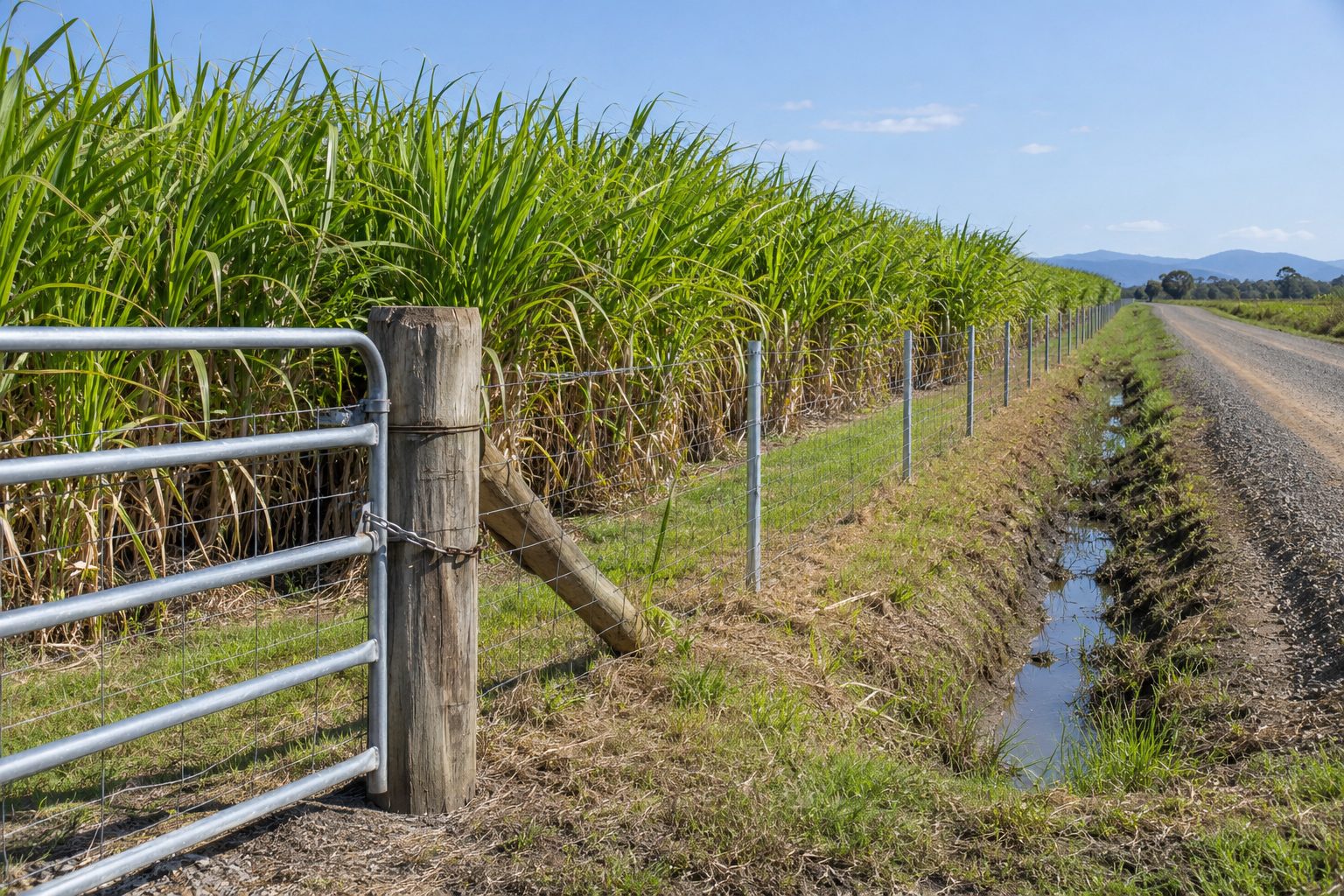
Cane farm fencing around Mackay usually starts with one question: who pays for the boundary? The Neighbourhood Disputes (Dividing Fences and Trees) Act 2011, in the version we found, says that for adjoining land consisting of two parcels of agricultural land, the dividing fence chapter does not apply to the common boundary. This page applies those words to cane, says where they stop, and covers roads, drains, flood country and the quote. We are a referral service: your enquiry is passed to a local contractor, who does the work and is responsible for holding any licence or registration that applies.
The general explainer is the dividing fence law page. This page is the cane version.
What the Act says about two cane blocks
Section 18 says "Agricultural land is rural land of more than half a hectare used for cultivating crops on a commercial basis". Section 8(3) says: "For adjoining land consisting of 2 parcels of agricultural land, this chapter does not apply to each parcel of land for the common boundary between the parcels of land." On those words, two commercial cane blocks, each of more than half a hectare, are two parcels of agricultural land, and the chapter does not apply to their common boundary. Whether your two parcels meet the definition depends on how each is used, so ask QCAT or a solicitor if you are unsure.
Some State web summaries word the agricultural land rule more loosely than the Act. This site uses the Act's wording and does not copy theirs. The Queensland Law Handbook, a secondary source with a July 2016 disclaimer date, says that where both parcels are agricultural land, neighbours rely on agreement or common law, and that agreements generally do not bind later buyers (Queensland Law Handbook). Later amendments to the Act were not checked.
Where the carve-out stops
The carve-out is about two parcels of agricultural land. A cane block beside grazing land, a lifestyle block, a road, a creek or a stock route is a different case, and the words above do not say how the Act treats it. We do not interpret those boundaries. Ask QCAT, the council or a solicitor.
Two points can be stated from the Act's words. Section 15(2) says the owners of agricultural or pastoral land on either side of a road are adjoining owners if they agree, or if QCAT decides a fence has been used, or could reasonably be used, as a dividing fence for the two parcels. And section 8(2)(a) says the chapter does not apply to a stock route. Which Mackay-area roads are stock routes was not established, so ask the council. The creeks, roads and vegetation page covers the checks.
Cane country in numbers
Mackay Regional Council's agriculture page, which is undated, gives about 80,000 hectares of cane cultivated and about 69,000 harvested (council agriculture page). A sugar milling company's cane supply page lists more than 1,200 cane farms, from about 5 ha to over 900 ha, a 832 km cane rail network with approximately 280 sidings, and a crushing season that typically runs June to December (cane supply page).
The region profile gives sugar cane an estimated $329.3 million, attributed to ABARES, 2020, which is below beef, the largest sector on that page (region profile). A 2013 regional report, which is old and uses different years and boundaries, put cane at about 18 per cent of the catchment and close to 96 per cent of intensive agriculture (the 2013 report). In the Walkerston-Eton area, sugar cane growing employed 229 people, 5.3 per cent of employment, at the 2021 Census (Census QuickStats).
Flood country, drains and creek edges
The Pioneer River floods fast: the peak travel time from Mirani to Mackay is generally 3 to 6 hours (Bureau of Meteorology flood brochure). The Pioneer Valley page has the flood record. For a fence along a drain or a creek edge, ask the contractor about set-back from the waterway and how the fence is laid to the direction of flood flow, which one regional fact sheet raises (see the storm and flood page). Section 12(2) of the Act deals with a fence built on a line other than the common boundary, and its conditions were not re-read, so read the section and ask the council about watercourses.
On the city edge, where cane land meets house blocks, see the Mackay and city fringe page. Sarina is on the Sarina page.
Pigs, gates and access
A regional natural resource management body has published pig exclusion guidance for the Mackay, Whitsunday and Isaac region, and Mackay Regional Council's pest management page lists feral pigs among local animals classified as pests. Neither says pigs damage cane fences at any named place, so we make no such claim. If you want to ask about a pig-proofing option, the exclusion page gives the published designs.
On access, the crushing season and the wet season both affect when a contractor can reach a block, and no source we read sets a calendar. Ask the contractor how they plan around both, and how gates suit the machinery that uses the block. The cost guide lists the lines a quote should itemise, and we publish no prices.
Licence and approvals
Whether a cane boundary fence needs a QBCC licence is not something the pages we found settle, and this site makes no claim either way. Ask the contractor which licence or registration they hold, check it on the QBCC register (139 333), and see the licence page.
What this page cannot do
It cannot tell you whether your boundary is inside or outside the dividing fence Act, because that depends on how both parcels are used and on words we do not interpret. It cannot say what happens where cane meets grazing land, a road, a creek or a lifestyle block. It cannot give a price or a lifespan, or say which licence or registration a contractor needs. Area and industry figures come from the sources named, some of them old or undated. Ask QCAT, the council, a solicitor, QBCC and the contractor for your block.
Check the current rules before you rely on this
This page describes what the Queensland dividing fence Act says about a boundary between two parcels of agricultural land, and the cane farming facts we found for the Mackay region. It describes the rules in general terms as they stood in November 2026. Standards, forms, thresholds and fines change.
The authoritative sources are Neighbourhood Disputes (Dividing Fences and Trees) Act 2011 (Qld), version in force from 1 August 2025, Mackay Regional Council, agriculture (undated), A sugar milling company's cane supply page (industry figures; the company is not named on the site), A regional natural resource management body, State of the Region 2013, agriculture chapter (old; different boundaries) and Queensland Government, Mackay, Isaac and Whitsunday region profile (industry figures attributed to ABARES 2020). Where anything here differs from those sources, they are right and we are not.
We are not fencing contractors, builders, regulators or lawyers. For what applies to your fence, ask the contractor which licence or registration they hold and check it on the QBCC register (139 333), then ask the council that covers the land: Mackay Regional Council (1300 622 529), Whitsunday Regional Council (1300 972 753) or Isaac Regional Council (contact details on its website).
Accurate at the time of writing, November 2026. Always check the source before relying on it.