Farm fencing in Mackay: what this page covers
Farm fencing for cattle around Mackay can mean a post and wire fence that holds stock in a paddock or along a boundary. This page explains how one regional fact sheet describes that fence, which words a quote will use, what the Queensland dividing fence Act says about a boundary between two grazing properties, and what to ask before you agree to a price. We are a referral service: your enquiry is passed to a local contractor, who does the work and is responsible for holding any licence or registration that applies.
The page is about stock fencing only. Cane boundaries are on the cane page, pig and wild dog fences on the exclusion page and horse paddocks on the horse and lifestyle page.
Where cattle fencing is needed
The Queensland Government region profile calls the beef cattle industry the largest agricultural production sector in the Mackay, Isaac and Whitsunday region, at an estimated $627 million, and attributes the figure to ABARES, 2020 (region profile). A 2013 regional report, which is old and uses different years and boundaries, gave grazing as the largest land use at 65 per cent and said roughly 80 per cent of beef enterprises were coastal (the 2013 report).
West of the coast the census shows the same pattern. In the Broadsound-Nebo area, beef cattle farming was 9.3 per cent of employment, or 363 people, at the 2021 Census (Census QuickStats). Those are employment shares, not counts of paddocks or fence length. Local detail is on the Nebo and Broadsound page.
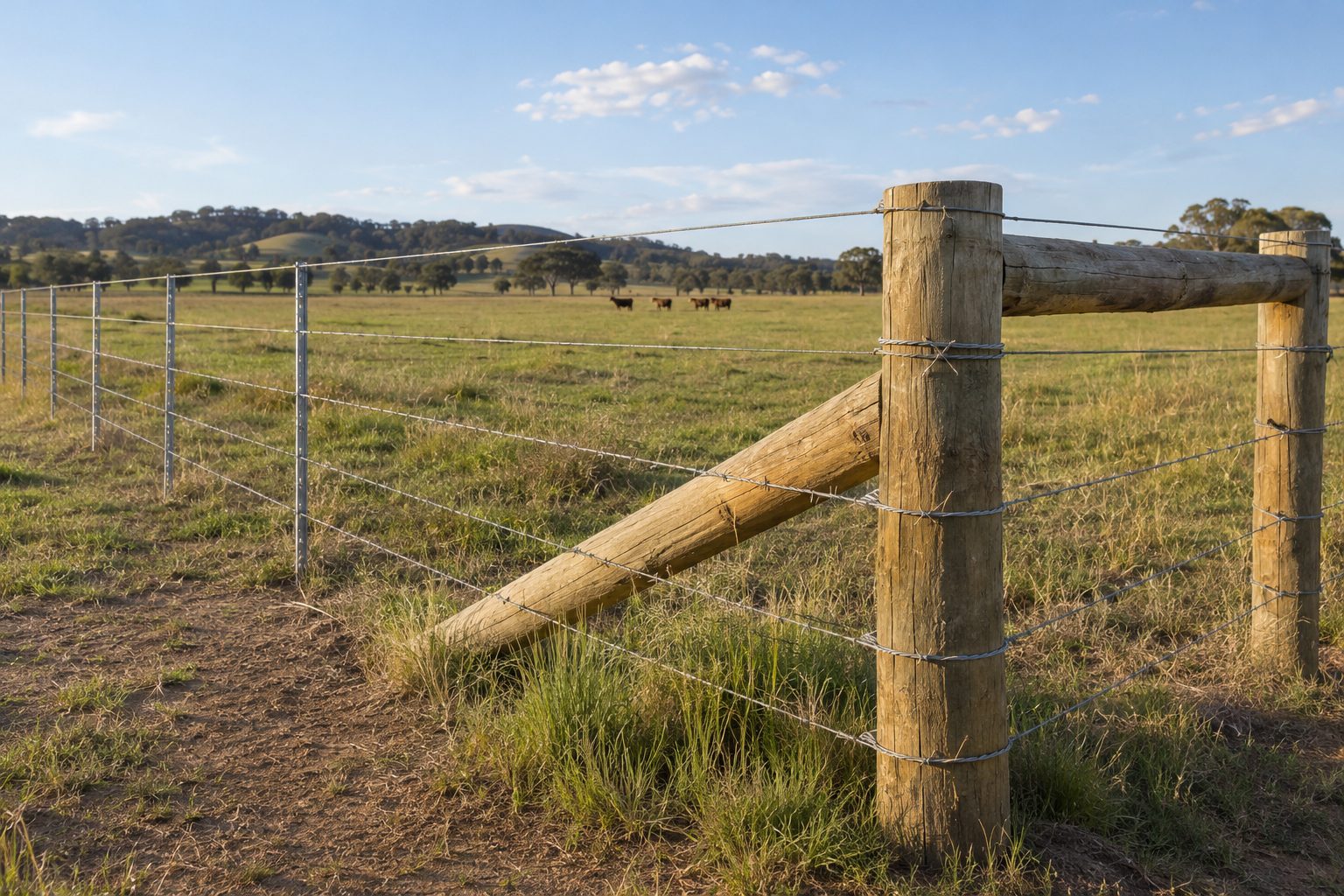
A four-strand cattle fence: the parts
One regional fact sheet, dated August 2023 and funded by the Australian Government, describes a cattle fence for landholders in the Mackay, Whitsunday and Isaac region (regional fence selection fact sheet). It says it is general information and not mandatory standards. It gives no fence height. What it does describe is below, and it is the source for everything in the table.
| Part | What the fact sheet says | Ask the contractor |
|---|---|---|
| Strainer assemblies | Timber or steel strainers. | How many the fence needs, where, and what type. |
| Posts | About 20 m apart. | What spacing they propose on your ground, and why. |
| Pickets | About 5 m apart. | Steel or other, and how they are set. |
| Wire | Four strands of barbed wire. | Barbed, plain or a mix, and how many strands. |
| Top wire | Replacing the top wire with plain wire reduces harm to wildlife such as bats, gliders and birds. | Whether a plain top wire is in the quote. |
The same sheet says it is critical to obtain several quotes, and that local rural supply agencies are a good source of advice. We found no neutral source for how long any part lasts, so this site gives no figure. The posts guide covers timber hazard classes and the questions to ask about treatment.
A boundary between two grazing properties
The Neighbourhood Disputes (Dividing Fences and Trees) Act 2011, in the version we found, in force from 1 August 2025, treats a boundary between two grazing parcels differently from one between two cropped parcels. Section 18 says pastoral land is "rural land of more than half a hectare used for grazing stock on a commercial basis". For two parcels of pastoral land, section 13(1)(b) says a dividing fence is sufficient if it can "restrain livestock of the type grazing on each of the parcels of land". The Act sets no height for pastoral land.
Section 21(1) says adjoining owners "are each liable to contribute equally to carrying out fencing work for a sufficient dividing fence". Under section 21(2), an owner who wants a higher standard is liable for the work "to the extent that it is greater than the standard for a sufficient dividing fence". Section 13(1)(c)(i) also treats a fence as sufficient if the adjoining owners agree it is.
That is as far as we go. Cattle beside cane, a lifestyle block, a road, a creek or a stock route is not settled by those words, and a stock route is outside the chapter under section 8(2)(a). For those boundaries, ask QCAT, the council or a solicitor. Later amendments to the Act were not checked. The dividing fence law page has the rest, and the notice page has the steps once you serve a notice.
What a quote should itemise
Ask for a written quote that lists the length and line, the strainers and gates, the post type and treatment or galvanising, the wire and the number of strands, and how it is tied off and strained. Ask who locates the boundary, who clears the line and who confirms the vegetation category (see the creeks, roads and vegetation page). If part of the fence is electric, the electric fencing guide covers the energiser and the earth. The cost guide goes through each line and the checklist for comparing quotes. We publish no prices.
Flood country changes the design. Where a paddock fence crosses low ground or a creek, the storm and flood page covers the flood-friendly points the fact sheet raises.
Safety before posts go in
A carrier's media release we read treats driving in a star picket as ground-breaking work and says to dial 1100 in business hours. It does not mention fence posts, so ask the contractor whether an underground services check is part of the job. On post drivers, WorkSafe Queensland updated an alert in July 2026 about a tractor-mounted post driver failure in which a farmer was fatally injured in April 2024. It recommends not relying on a single component to restrain the mast, a rated backup restraint such as a safety chain, pre-use inspection of hoses, pins, brackets and welds, trained operators and keeping people clear (WorkSafe alert).
Licence and approvals
Whether a cattle fence needs a QBCC licence is not something the pages we found settle, and this site makes no claim either way. Ask the contractor which licence or registration they hold, check it on the QBCC register (139 333), and read the licence page for what the pages say and where they stop. On council approval, the Mackay planning pages we found do not mention fences, so ask the council that covers your land.
What this page cannot do
It cannot design a fence for your paddock, because the right spacing, height, wire and bracing depend on your stock, your ground and your fence line. It cannot give a price or a lifespan, and it cannot say what licence or registration a contractor needs, because the pages we found do not settle it. It cannot say whether the dividing fence Act covers a boundary where the neighbour's land is used differently from yours. The design points come from one regional fact sheet that calls itself general information, and should be read that way. Ask the contractor, the council and QBCC for your block.
Check the current rules before you rely on this
This page describes how one regional fact sheet sets out a cattle fence and what the Queensland dividing fence Act says about a boundary between grazing parcels. It describes the rules in general terms as they stood in November 2026. Standards, forms, thresholds and fines change.
The authoritative sources are A regional natural resource management body, fence selection fact sheet, August 2023 (general information, not mandatory standards), Neighbourhood Disputes (Dividing Fences and Trees) Act 2011 (Qld), version in force from 1 August 2025, Queensland Government, Mackay, Isaac and Whitsunday region profile (industry figures attributed to ABARES 2020) and WorkSafe Queensland, alert: tractor-mounted post driver failure (updated 7 July 2026). Where anything here differs from those sources, they are right and we are not.
We are not fencing contractors, builders, regulators or lawyers. For what applies to your fence, ask the contractor which licence or registration they hold and check it on the QBCC register (139 333), then ask the council that covers the land: Mackay Regional Council (1300 622 529), Whitsunday Regional Council (1300 972 753) or Isaac Regional Council (contact details on its website).
Accurate at the time of writing, November 2026. Always check the source before relying on it.